
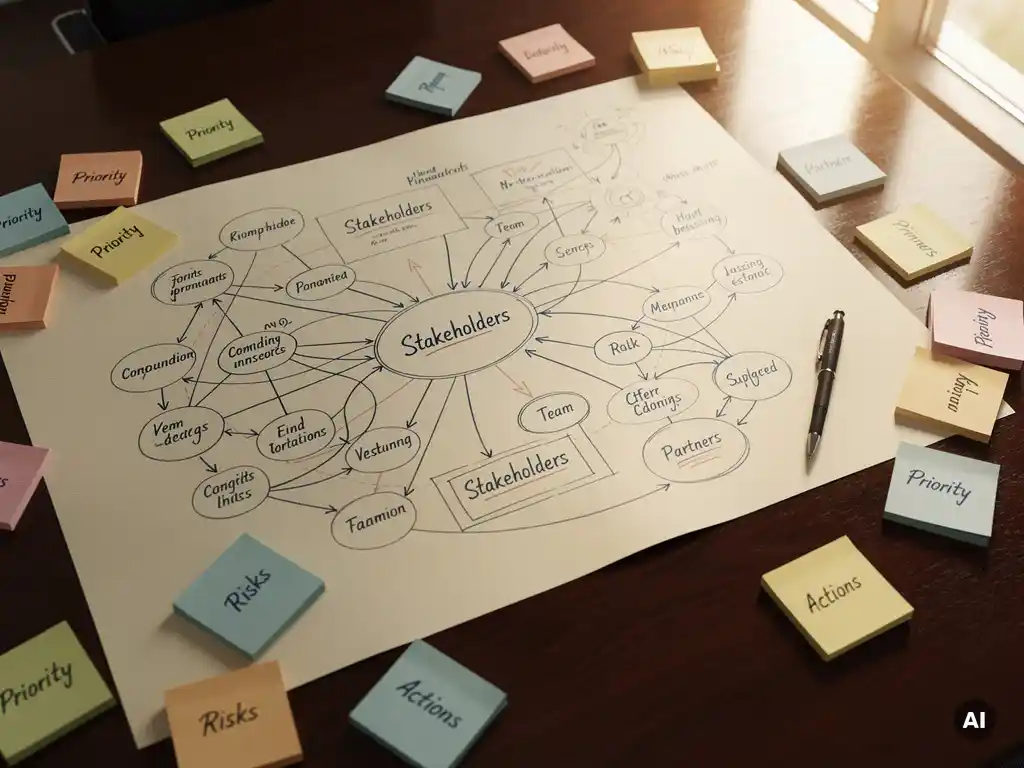
Stakeholder mapping is the systematic process of identifying all parties involved in or affecting an organisation, including their interests, expectations, and mutual relationships. You do this before a crisis because in the heat of the moment you have no time to start from scratch: who are the key players, how do you reach them, and what do they expect from you? A solid stakeholder map is the foundation of any crisis preparedness effort. The questions below help you understand how to build and deploy that map.
Which stakeholders are most critical during a crisis?
The most critical stakeholders during a crisis are those directly affected by the situation, those with the power to escalate or contain the crisis, or those whose trust is decisive for the organisation’s survival. Which groups these are in practice depends on the type of crisis.
In a restructuring or collective redundancy, employees, trade unions, and works councils are the most urgent group. In a cyber incident, it is customers, regulators, and IT partners. In a product crisis, consumers, distributors, and supervisory authorities take priority. In an operational incident, local residents, local authorities, and the media can be decisive.
In practice, there are five categories that are relevant in almost every organisational crisis:
- Internal stakeholders: employees, management, board of directors, trade unions
- External regulators and governments: regulators, inspection services, policymakers
- Business partners: customers, suppliers, distributors, shareholders
- Media and public opinion: journalists, social media, opinion leaders
- Local community and civil society organisations: local residents, NGOs, sector organisations
Critical does not always mean vocal. A regulator quietly opening an investigation, or a major customer harbouring internal doubts, can have more impact than a critical tweet. Stakeholder mapping helps you identify precisely those less visible but influential parties in a timely manner.
How do you map stakeholders before a crisis?
Mapping stakeholders before a crisis means systematically inventorying who is involved with the organisation, what interests they have, how much influence they can exert, and how sensitive they are to specific risk scenarios. This process results in a stakeholder map that serves as the foundational tool for crisis preparedness.
A workable approach proceeds in the following steps:
- Identify all relevant parties based on existing relationships, contracts, permits, regulations, and previous issues. Think broadly: even dormant stakeholders such as former employees or local action groups can quickly become active during a crisis.
- Analyse interests and expectations per stakeholder group. What do they know about the organisation? What do they expect in the event of an incident? What information do they need?
- Assess influence and dependency. Who can affect the organisation through media, regulation, breach of contract, or public pressure? Who is dependent on the organisation?
- Link stakeholders to risk scenarios. Not every stakeholder is relevant in every crisis. By linking scenarios to stakeholder profiles, you know in advance which groups take priority in which situation.
- Establish contact lists and communication protocols. Names, roles, direct contact details, and preferred channels per stakeholder group. This is the operational translation of the analysis.
A stakeholder map is not a one-off document. Organisations and their environments change constantly, so an annual update is a minimum requirement. During major strategic changes — such as a merger, a new location, or a change in the product portfolio — an interim update is advisable.
What is the difference between a stakeholder analysis and a risk analysis?
A stakeholder analysis maps who the involved parties are and how they relate to the organisation. A risk analysis inventories which situations, incidents, or developments can affect the organisation. Both are indispensable for crisis preparedness, but they answer different questions: the stakeholder analysis asks who, the risk analysis asks what.
In practice, both analyses reinforce each other. A risk analysis without a stakeholder perspective misses the question of who is affected and who responds. A stakeholder analysis without risk context provides insufficient guidance for determining which stakeholders deserve priority in which situation.
The combination of both yields scenario-specific stakeholder priorities: in a cyber incident, regulators and affected customers are most urgent; in a labour dispute, it is trade unions and internal communication channels. By analysing risks and stakeholders together, you build crisis preparedness that goes beyond generic action plans.
Why do stakeholder priorities shift during a crisis?
Stakeholder priorities shift during a crisis because the nature of the situation determines who is most affected, who has the greatest influence on how events unfold, and who needs to be informed most urgently. What is a peripheral stakeholder under normal circumstances can move to centre stage in a specific incident.
An example: in normal business operations, local residents are rarely a priority for the communications department. In an operational incident with external impact — such as a fire or an environmental leak — they immediately become a key group. At the same time, shareholders who are normally informed through quarterly reports may, in the case of a listed company, expect the organisation to communicate within hours.
This dynamic nature of stakeholder priorities is precisely why a static list is not enough. A good stakeholder map contains not only who the stakeholders are, but also under what circumstances they move to the foreground. Scenario linking makes it possible to quickly set the right priorities at the start of a crisis without losing valuable time in internal deliberations about who should be contacted first.
Who is responsible for stakeholder communication in a crisis?
Responsibility for stakeholder communication in a crisis lies with the crisis team, but execution is distributed across multiple functions based on the relationship with the stakeholder. Communications acts as the coordinating function, not as the sole executor.
In practice, this means that HR coordinates communication to employees and trade unions, Legal co-monitors communication to regulators and supervisory authorities, Investor Relations or the CFO addresses shareholders, and the spokesperson or communications director manages media contacts. The CEO or a designated member of the executive team acts as the face of the organisation to the outside world.
The greatest risks in stakeholder communication during a crisis are contradictory messages and gaps in communication. When HR, Legal, and Communications each communicate separately without coordination, inconsistencies arise that further undermine trust. Clear governance — with a single central crisis team maintaining oversight and coordinating all outgoing communication — is therefore not a luxury but an operational necessity.
How do you use a stakeholder map during acute crisis management?
During an acute crisis, you use the stakeholder map as an operational navigation tool: based on the map, you determine which stakeholders are contacted first, which messages apply to each group, and through which channels you communicate. The map translates the preparatory analysis into concrete action under time pressure.
In the first hours of a crisis, three questions are guiding: who already knows or will soon find out, who has the most influence on how the crisis unfolds, and who needs information right now? The stakeholder map provides a well-founded answer to each of those questions, without the crisis team losing time reconstructing relationships and contact details.
Concretely, you use the map for:
- drawing up a priority list for the first 24 hours
- aligning key messages per stakeholder group
- assigning communication responsibilities within the crisis team
- monitoring responses and adjusting the communication strategy
A stakeholder map that exists only on paper and has never been tested offers limited value in an acute situation. Crisis training and simulations are the way to verify whether the map is accurate, whether contact details are up to date, and whether the internal division of responsibilities works in practice. Crisis communication and issue management therefore presupposes that preparation and practice go hand in hand.
How Whyte helps with stakeholder mapping and crisis preparedness
Whyte Corporate Affairs supports larger organisations in building robust crisis preparedness, with stakeholder mapping as one of the central building blocks. This is not done as a standalone document, but as part of an integrated approach that connects strategy, governance, and communication.
Concretely, Whyte supports with:
- conducting a stakeholder analysis linked to specific risk scenarios
- drafting or updating a crisis communication plan with stakeholder priorities
- defining governance, escalation processes, and crisis team structures
- crisis training and simulations to test the stakeholder map under realistic conditions
- coaching executives and spokespeople in their communication role during a crisis
- collaboration with HR, Legal, Risk, IT, and Operations for a coherent approach without communication silos
Whyte combines senior strategic advice with hands-on execution and has broad experience with complex, sensitive matters in the Belgian institutional and media context. Want to know how your organisation currently stands in terms of crisis preparedness and stakeholder mapping? Get in touch for an initial conversation.
Frequently Asked Questions
How often should you update a stakeholder map, and what are the signals that an update is urgently needed?
An annual review is the minimum requirement, but certain events call for an immediate interim update: a merger or acquisition, new market regulation, a change in executive leadership or the board of directors, or a previous crisis that brought new stakeholder groups to light. In practical terms, you can assign a fixed owner for the stakeholder map — for example the communications manager or the risk manager — who initiates an update each time one of these triggers occurs. An outdated map with incorrect contact details or missed stakeholders can sometimes be more dangerous in an acute crisis than having no map at all.
What if a crucial stakeholder turns out to be unreachable or uncooperative during a crisis?
This is precisely why the stakeholder map must also include alternative contact persons and indirect channels: a second point of contact within the same organisation, a shared partner who can act as an intermediary, or a sector organisation through which you can reach the group. If a stakeholder is deliberately uncoöperative, it is important to document that stance and understand what interest or grievance underlies it. Sometimes engaging a neutral third party or mediator is the most effective strategy to get communication moving.
How do you handle stakeholders with conflicting interests during the same crisis?
Conflicting interests are the rule rather than the exception: what a trade union expects sometimes directly contradicts what shareholders want to hear, and what regulators demand can clash with the interests of customers. The key is to craft a tailored message for each stakeholder group that is honest and consistent on the facts, while connecting to the specific context and expectations of that group. What you must avoid at all costs are contradictory factual claims: tone may vary, facts may not. A central crisis team that coördinates and approves all outgoing communication is the most reliable structure for this.
Are there digital tools or software solutions that help manage a stakeholder map?
Specialised stakeholder management software such as Darzin, Borealis, or Simply Stakeholders exists, but for many organisations a well-structured and secure environment in existing tools such as SharePoint, Notion, or even a well-managed Excel document linked to a CRM system is sufficient. The most important criterion is not the tool itself, but accessibility during a crisis: the map must be quickly consultable by all relevant crisis team members, including outside office hours and even when internal systems may be disrupted — an offline backup is therefore not an unnecessary luxury.
How do you effectively involve internal stakeholders such as employees in crisis preparedness without creating unnecessary anxiety?
The key is framing: present crisis preparedness not as an alarm signal, but as a sign of professional maturity — comparable to fire drills or IT backup procedures. Employees who know what is expected of them in a crisis situation are calmer and more effective than employees who hear for the first time how the organisation responds at the moment something goes wrong. Actively involve key functions such as HR, Legal, and operational management in building the stakeholder map and crisis exercises, so that the preparedness is embedded throughout the organisation rather than living as a document in the communications department.
What are the most common mistakes organisations make in stakeholder communication in the first hours of a crisis?
The most damaging mistakes are: communicating too late in the hope that the situation will resolve itself, communicating too little so that stakeholders fill the void with speculation, and communicating inconsistently because different departments go public separately without coordination. A fourth common mistake is communicating as if all stakeholders have the same information needs: a press release that is also distributed internally, or an internal memo that inadvertently reaches the press, reflects a lack of stakeholder differentiation. The first 24 hours largely determine how the crisis unfolds — a well-prepared stakeholder map significantly shortens response time.
How do you know whether your crisis preparedness and stakeholder map are effective enough without waiting for a real crisis?
The most reliable method is a realistic crisis simulation in which the stakeholder map is actually used under time pressure: can crisis team members quickly find the right contacts, are the contact details accurate, do those responsible know which message to deliver to each group and through which channel? Additionally, you can organise a tabletop exercise in which the management team works through a fictional crisis scenario and evaluates decision-making. The outcome of such an exercise always yields concrete points for improvement — and discovering those gaps in a controlled environment is precisely the point.
Related Articles
- What Is the Importance of Media Training for Executives in Times of Crisis?
- How Does an Organization Deal With Disinformation During a Crisis?
- What Should a CEO Communicate During a Serious Business Crisis?
- How to Recognize Early Warning Signs of an Emerging Reputation Crisis
- What Is Issue Management and How Does It Differ From Crisis Communication?
This content was generated with the help of AI and it may contain mistakes