
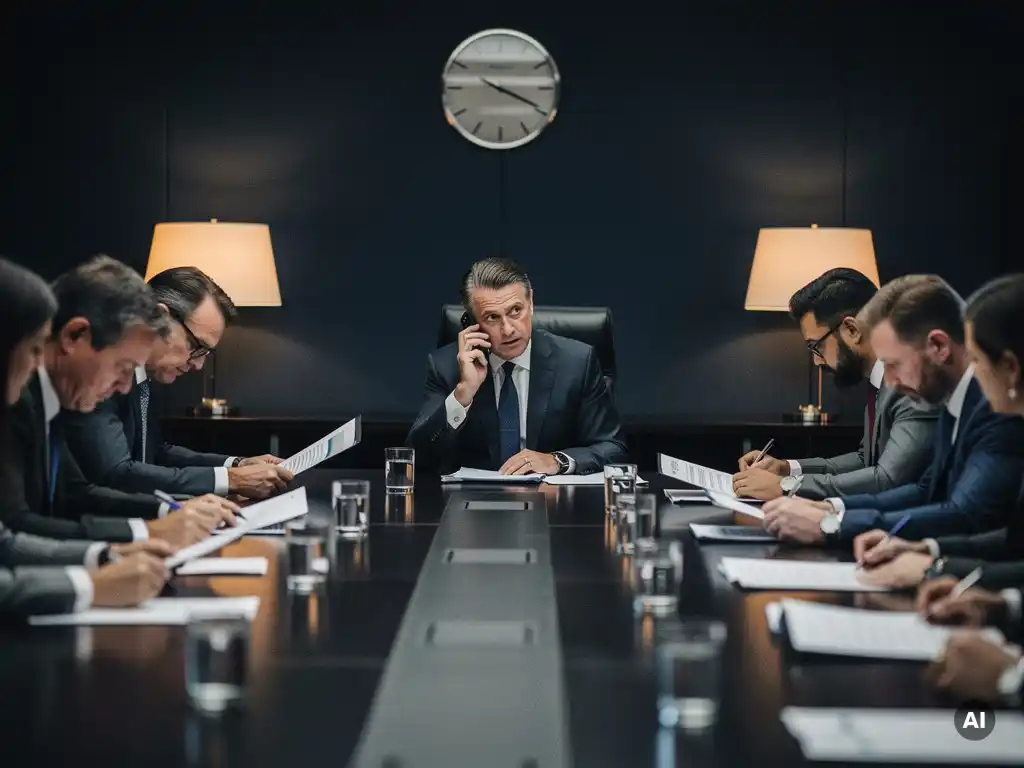
A crisis simulation is a structured exercise in which an organisation runs through a realistic crisis scenario without an actual crisis taking place. The goal is to test how well the crisis team, management, and communications leads perform under pressure. This makes weak links in processes, decision-making, and communication visible before they cause damage in a real crisis.
A crisis simulation therefore differs fundamentally from theoretical training: participants are confronted with realistic time pressure, incomplete information, and escalating situations. That makes it one of the most effective tools for crisis preparedness. In this article, we answer the most frequently asked questions about crisis simulations: how they work, who participates, what they deliver, and when to start.
How does a crisis simulation work in practice?
A crisis simulation unfolds in phases: a realistic crisis scenario is revealed step by step through injects — new pieces of information that cause the situation to evolve. Participants must make decisions, communicate, and collaborate as if the crisis were actually happening. Afterwards, a structured debriefing analyses how events unfolded.
In practice, a typical crisis simulation looks like this:
- Preparation: Facilitators develop a scenario tailored to the organisation’s specific risk profile. Injects are prepared: news articles, social media posts, press releases, internal notifications, and questions from journalists or stakeholders.
- Briefing: Participants receive the initial information. They know it is an exercise, but conditions are made as realistic as possible.
- Execution: The crisis escalates through successive injects. Participants must communicate, make decisions, formulate messages, and inform internal and external stakeholders.
- Debriefing: After the exercise, strengths and areas for improvement are discussed. Where did decision-making stall? Which messages were unclear? Who was missing from the table?
Duration ranges from half a day to a full day, depending on the complexity of the scenario and the number of participants. Some organisations opt for a tabletop exercise, where the scenario is discussed without active execution. Others choose a fully simulated crisis environment with live media, social media, and time pressure.
Which crisis scenarios are simulated most often?
The most frequently simulated crisis scenarios are restructurings and collective redundancies, cyber incidents and data breaches, operational accidents, product issues or recalls, and reputational crises caused by public criticism or media attention. The choice of scenario always depends on the organisation’s specific risk profile.
Relevant scenarios that organisations in Belgium regularly practise include:
- A cyber incident in which customer or employee data is compromised
- A workplace accident with seriously injured or fatal victims
- An announcement of restructuring or the closure of a site
- A product recall involving consumer safety risks
- Negative media coverage or an attack via social media
- A judicial investigation or search
- An M&A transaction that lands badly internally or externally
A good scenario is not the most spectacular, but the most probable. The greatest value lies in practising situations that could realistically affect the organisation, not in simulating exceptional disaster scenarios that are entirely out of context.
Who should participate in a crisis simulation?
A crisis simulation is most valuable when all members of the crisis team participate: typically the CEO or managing director, the communications lead, the legal adviser, HR, Operations, and — depending on the scenario — IT or the CISO. The simulation tests not only individuals, but above all the collaboration between functions.
In the Belgian business context, it is important to also consider the multilingual dimension: who communicates in which language, to which stakeholders? Who is the spokesperson for Dutch-language and French-language media? Who liaises with trade unions or social partners?
In addition to the crisis team, spokespersons, board members, and external advisers can also be involved. Some organisations choose to structure the simulation in two layers: a strategic layer at executive level and an operational layer with communications staff and other operational functions. This gives a more realistic picture of how information flows and decisions are made in an actual crisis.
What does a crisis simulation concretely deliver for an organisation?
A crisis simulation gives organisations concrete insight into what works and what does not: in decision-making, internal communication, collaboration between functions, and the quality of external messages. That insight is the foundation for targeted improvements in crisis processes, governance, and communication.
More concretely, a well-executed crisis exercise delivers the following:
- Blind spots become visible: Who has which authority? Who informs whom and when? Where does internal communication break down?
- Messages are tested: Are the key messages clear, consistent, and credible under pressure?
- Roles become clearer: Who is the spokesperson? Who makes the final decision? Who monitors the legal boundaries?
- Procedures are tested: Does the crisis plan work in practice, or does it remain on paper?
- Confidence grows: Teams that have worked through a crisis together — even a simulated one — respond faster and more calmly in a real crisis.
A crisis simulation is therefore also an investment in reputation management: organisations that are well prepared communicate faster, more consistently, and more credibly. That makes a measurable difference in how stakeholders perceive the organisation during and after a crisis.
What is the difference between a crisis simulation and crisis training?
Crisis training focuses on transferring knowledge and skills: what is crisis communication, how does a crisis team work, how do you deal with the media. A crisis simulation applies that knowledge in a realistic environment. Both are complementary, but a simulation tests what training has taught.
In crisis training you learn the principles: how do you formulate a holding statement, how do you prioritise stakeholders, what are the pitfalls in spokesperson work. In a crisis simulation you must apply those principles while a journalist is calling, social media is escalating, and management is asking for a decision.
The most effective approach combines both. An organisation that has never thought about crisis communication will get more out of training before running a simulation. An organisation that already has a crisis plan and wants to test its team is ready for a full simulation. Media training for spokespersons is a third, complementary form: it focuses specifically on performing in front of a camera or microphone, not on the broader crisis process.
When is the right time to plan a crisis simulation?
The right time for a crisis simulation is before a crisis occurs. Organisations that wait until an incident happens miss the primary benefit of the exercise: strengthening processes and teams in calm conditions, without reputational risk.
There are specific moments when a crisis simulation is particularly valuable:
- After a significant organisational change, such as a merger, acquisition, or new leadership
- When the crisis plan has been revised or drawn up for the first time
- When the composition of the crisis team has changed
- When the risk profile is elevated — for example due to an ongoing restructuring, a legal case, or an upcoming public announcement
- As a periodic exercise, preferably every one to two years
A crisis simulation is not a one-off activity. Crises evolve, organisations change, and new risks emerge. Regular practice ensures that preparedness remains current and that new employees or board members know and master the crisis processes.
How Whyte helps with crisis simulations and crisis preparedness
Whyte Corporate Affairs supports larger organisations and multinationals through the full preparation for organisation-related crises, from risk analysis and scenario planning to crisis training and crisis simulation. Our approach is integrated: we connect crisis communication, stakeholder management, internal communication, and media relations within one coherent strategy, tailored to the Belgian institutional and media context.
What Whyte concretely offers in the area of crisis preparedness:
- Development of realistic crisis scenarios based on your organisation’s risk profile
- Facilitation of tabletop exercises and full crisis simulations for management and crisis teams
- Crisis training and media training for spokespersons and executives
- Development and review of crisis plans, escalation processes, and crisis communication protocols
- Debriefing and concrete recommendations after the simulation
- Collaboration with internal functions such as Communications, HR, Legal, Risk, IT, and Operations
Would you like to know how your organisation currently stands in terms of crisis preparedness, or would you like to organise a crisis simulation? Contact Whyte Corporate Affairs for a no-obligation conversation.
Frequently Asked Questions
How long does it take to prepare a crisis simulation?
The preparation time for a crisis simulation typically ranges from two to six weeks, depending on the complexity of the scenario and the size of the organisation. During this period, the organisation’s risk profile is analysed, realistic injects are developed, and logistics are coordinated with participants. Good preparation is crucial: the better the scenario reflects the organisation’s reality, the more valuable the exercise.
What if our organisation does not yet have a formal crisis plan — can we still run a crisis simulation?
A crisis simulation is also worthwhile without a fully developed crisis plan, but the approach differs. In that case, the simulation functions as a baseline assessment: it maps what is missing and lays the groundwork for drawing up a crisis plan. It is advisable to first complete a basic training so that participants are familiar with core concepts such as stakeholder prioritisation, holding statements, and the role of the crisis team.
How realistic are the simulated media and social media elements during an exercise?
In a full crisis simulation, fake news articles, simulated social media posts, fake press releases, and even live phone calls from fictitious journalists can be used as injects. This significantly increases the pressure and forces participants to respond as they would need to in a real crisis. The more realistic the media pressure, the better the simulation exposes weak spots in spokesperson performance and decision-making.
What are the most common mistakes organisations make during a crisis simulation?
The most common mistakes are: waiting too long to communicate with external stakeholders, unclear decision-making authority within the crisis team, and formulating messages that are legally safe but communicatively weak. Another frequent mistake is that internal communication is neglected while all attention is directed outward, leaving employees uninformed and allowing rumours to spread. It is precisely these patterns that a simulation makes visible and open for discussion.
Can external parties such as lawyers, PR agencies, or investors also participate in the simulation?
Yes, and in many cases this is even advisable. External advisers who play a role in a real crisis — such as lawyers, financial advisers, or external communications agencies — can also be involved in the simulation. This tests not only internal collaboration, but also coordination with external partners under time pressure. It is important to agree in advance on confidentiality and the scope of their role during the exercise.
How do you measure the effectiveness of a crisis simulation afterwards?
Effectiveness is primarily measured through the structured debriefing immediately after the exercise, during which facilitators share concrete observations and recommendations. In addition, scorecards or evaluation rubrics can be used to assess decision-making, communication speed, and message quality. The real measure, however, is the follow-up: are the recommendations from the debriefing translated into concrete adjustments to the crisis plan, governance, or communication protocols?
How often should an organisation repeat a crisis simulation to remain truly well prepared?
The rule of thumb is to organise a crisis simulation every één à two years, but certain circumstances call for a faster repeat: a new CEO or change in crisis team composition, a significant merger or acquisition, or a substantially changed risk profile. In between, shorter tabletop exercises or scenario discussions can maintain readiness. Crisis preparedness is not a one-off project but a continuous process that evolves alongside the organisation.
Related Articles
- What Should a Spokesperson Do During a Company Crisis?
- What Should a CEO Communicate During a Serious Business Crisis?
- How Do You Prepare Employees for a Potential Business Crisis?
- Why Is Rapid Communication in the First Hours of a Crisis So Crucial?
- What Should an Organization Do After a Data Breach or Cyber Incident?
This content was generated with the help of AI and it may contain mistakes