
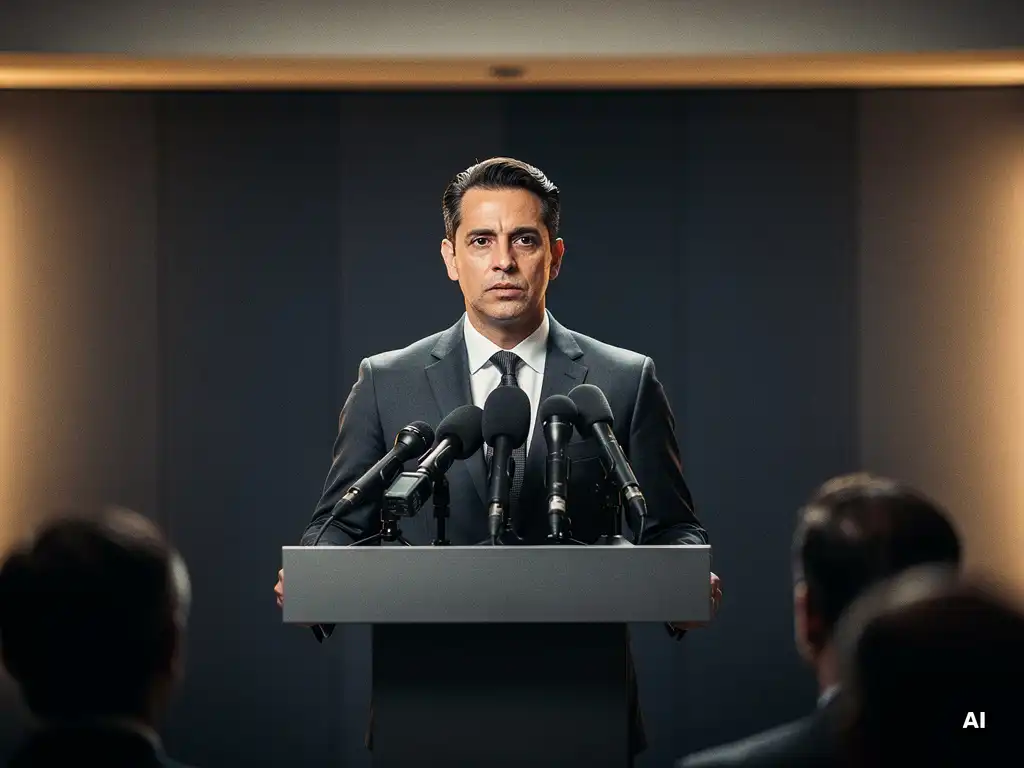
During a corporate crisis, the spokesperson is the face and voice of the organisation to the outside world. The core responsibility is clear: communicate in a timely, consistent, and credible manner on behalf of the organisation, while the facts are being gathered and the strategy is being determined internally. How that role takes shape depends on the type of crisis, the stakeholders involved, and the phase the organisation is in. The questions below provide practical answers to the most frequently asked questions about the role of a spokesperson during a corporate crisis.
What messages may and may not a spokesperson communicate?
A spokesperson communicates what the organisation knows with certainty at that moment, what it is doing to address the situation, and how it can be reached for further information. What has not yet been confirmed, what is legally sensitive, or what has not yet been internally aligned is not communicated. The line is not about staying silent, but about being honest about what is known and what is not.
In practice, this means that a spokesperson in the early phase of a crisis often works with a holding statement: a concise, factual statement that confirms the organisation is aware of the situation, that action is being taken, and that more information will follow as soon as it is available. This is not evasion, but a professional way to buy time for verification without leaving an information vacuum that gets filled by rumours or speculation.
What a spokesperson avoids in any case:
- Speculating about causes or questions of blame that have not yet been investigated
- Making promises about outcomes the organisation cannot guarantee
- Sharing information that has not yet been cleared legally or operationally
- Making statements that have not been internally aligned with Legal, HR, or management
- Emotional or defensive reactions that undermine credibility
How does a spokesperson prepare for a press conference during a crisis?
Good preparation for a press conference during a crisis does not begin on the day itself, but starts from a clear factual basis, aligned key messages, and a realistic assessment of the questions journalists will ask. Anyone who stands in front of the camera unprepared loses control of the narrative, even if the facts are on the organisation’s side.
Preparation concretely includes:
- Establishing the factual basis: What is certain, what is uncertain, what is still being investigated? Only confirmed information is communicated.
- Formulating key messages: A maximum of three to four messages that the organisation wants to convey consistently, aligned with management, Legal, and Communications.
- Drawing up a list of questions: Think from the journalist’s perspective: what are the most difficult, most critical questions? Prepare answers for scenarios that are uncomfortable.
- Practising bridging: Learn how to return from a difficult question to a key message without evading.
- Arranging practical logistics: Who stands next to the spokesperson? What documents are available? How does follow-up after the press conference proceed?
What are the most common mistakes made by spokespeople in a corporate crisis?
The most common mistake is communicating too late. Organisations that wait until they know all the facts leave an information vacuum that media and social media fill themselves. Other frequently made mistakes include responding defensively, delivering inconsistent messages to different stakeholders, and a lack of empathy for those affected by the crisis.
Other mistakes that regularly occur in practice:
- Failing to address the human dimension: Facts are important, but anyone who only communicates figures and procedures misses the emotional credibility that stakeholders expect.
- Not being internally aligned: When the spokesperson says something different from a manager or trade union representative, it immediately undermines trust.
- Speculating under pressure: Journalists sometimes ask questions that invite guessing. A spokesperson who confirms or denies speculation without a factual basis creates new problems.
- Ignoring social media: What is said at a press conference circulates online within minutes. Anyone who does not take digital distribution into account loses control of the narrative.
Who decides what the spokesperson says during a crisis?
What the spokesperson communicates is not determined by the spokesperson themselves, but by a crisis cell or crisis team that maintains control over the factual basis, the messages, and the stakeholder strategy. The spokesperson executes what has been internally aligned, but plays an active role in signalling what is communicatively feasible and credible.
In a well-functioning crisis structure, at least the following functions are involved in decision-making: management or CEO, Communications, Legal, and, depending on the type of crisis, HR, Risk, IT, or Operations. Communications acts as the connecting director: it monitors the consistency of messages across all channels and stakeholders, while Legal monitors the legal boundaries and Operations supplies the factual information.
A common organisational mistake is that the spokesperson operates too isolated, without a direct line to the crisis cell. This leads to delays, inconsistency, or messages that are not supported by management. The spokesperson is the face of communications, but not the decision-maker on content.
Does the CEO always have to speak personally during a corporate crisis?
Not always, but in serious crises with major societal or human impact, the CEO is expected to be visible. The choice of who acts as spokesperson depends on the nature and severity of the crisis, the target audience, and the communicative strengths of the available individuals. A CEO who is not communicatively skilled or insufficiently prepared can cause more damage than a well-prepared communications director.
The CEO typically speaks personally when:
- There are casualties or the crisis has a direct human impact
- Trust in the organisation as a whole is at stake
- Shareholders, governments, or regulators expect the highest level to speak out
- The crisis requires a strategic decision or change of course that only the CEO can confirm
In other cases, a communications director, operations director, or other executive may be better placed. What matters is that the spokesperson is credible, well-prepared, and authorised to speak on behalf of the organisation. The choice of the right spokesperson is itself a strategic communications decision.
How does a spokesperson handle aggressive or misleading questions from journalists?
A spokesperson responds to aggressive or misleading questions by remaining calm, correcting the premise of the question if it is factually incorrect, and then returning to the key message. Evading or going on the defensive is counterproductive: it creates the impression that the organisation has something to hide.
Concrete techniques that work:
- Correcting the premise: “That assumption is incorrect. What we know is…” followed by a factual correction.
- Bridging: Moving from the difficult question to the key message via a bridge such as “What I can confirm is…” or “What is central for us in this situation is…”
- Not repeating: Never literally repeat a negative framing or an accusation in the answer, not even to deny it.
- Setting limits without blocking: “That falls outside what I can confirm at this moment” is a legitimate answer, provided the spokesperson indicates when more information will follow.
Media training is indispensable here. Anyone who has never practised with critical journalists in a simulated setting is poorly prepared for the reality of a press conference under pressure. Experience in a safe practice environment makes the difference between a spokesperson who controls the narrative and one who is overwhelmed by it.
When is bringing in an external crisis communications advisor the right choice?
Bringing in an external crisis communications advisor is the right choice when internal capacity is insufficient, the crisis exceeds normal communications structures, or when an objective outside perspective is necessary to correctly assess the situation. The earlier an external advisor is involved, the more impact they can have on the course of the crisis.
External support adds value in situations such as:
- A crisis with significant media attention where the internal communications function lacks sufficient capacity or crisis experience
- A restructuring, collective redundancy, or M&A transaction where multiple stakeholder groups need to be addressed simultaneously
- A cyber incident or data breach where communications, Legal, and IT must work together simultaneously
- A situation where internal decision-making is blocked and a neutral party can take over the direction
- Preparation for a crisis that has not yet erupted but is already visible on the horizon
An external advisor does not replace the internal spokesperson, but strengthens the strategic layer: determining the right messages, monitoring consistency across stakeholders and channels, and coaching the spokesperson themselves. That combination of senior strategic advice and hands-on guidance is precisely what organisations need in a crisis.
How Whyte helps with spokesperson support during a corporate crisis
Whyte guides larger organisations and their management through all aspects of crisis communications, including the preparation and support of spokespeople. This guidance is integrated: messages, stakeholder priorities, internal communications, and media relations are viewed as a whole, not as separate tasks.
Concretely, Whyte offers support with:
- Drafting key messages, holding statements, and Q&A documents
- The strategic choice of the right spokesperson per target audience and crisis type
- Media training and crisis communications training for CEOs, communications directors, and other spokespeople
- Support during acute crises, including press conferences and stakeholder communications
- Crisis preparedness: vulnerability analyses, crisis communications plans, and simulations
- Evaluation and reputation recovery after the acute phase
Whyte works closely with management, Communications, Legal, HR, and other relevant functions within the organisation, and has strong knowledge of the Belgian media landscape and institutional context. Would you like to know how your organisation currently stands in terms of crisis preparedness and spokesperson capabilities? View our crisis communications services or get in touch for a no-obligation conversation.
Frequently Asked Questions
How long does a typical crisis communications phase last and when does a spokesperson switch to 'normal' communications?
There is no fixed timeline: the acute crisis phase lasts as long as the situation is actively alive in the media and among stakeholders. A spokesperson only switches to regular communications once the facts have been fully established, the organisation demonstrably has control over the situation, and the key stakeholders have been sufficiently informed. A structured evaluation after the acute phase helps determine when that transition is justified, and simultaneously forms the basis for reputation recovery.
What do you do if a spokesperson has communicated an error or provided incorrect information during the crisis?
Correct as quickly and proactively as possible, without waiting for the media to pick up on the mistake. An honest correction — ‘Based on new information, we need to revise our earlier statement’ — causes less reputational damage than a discovered mistake that the organisation tried to conceal. Transparency about the correction, combined with an explanation of why the information was initially incorrect, strengthens credibility rather than undermining it.
How do you as a spokesperson communicate consistently to different stakeholder groups that each expect different information?
The key messages remain identical for all groups, but the tone, level of detail, and channel are adapted to the specific stakeholder. What you communicate internally to employees differs in wording from what you say to journalists or shareholders, but must never be contradictory in substance. A Q&A document per stakeholder group, internally aligned by the crisis cell, is a practical tool for maintaining consistency without falling into a one-size-fits-all approach.
What role does social media play during a corporate crisis and how does a spokesperson align it with traditional press communications?
Social media dramatically accelerates the spread of information and misinformation, which means the timing of traditional press statements and social media updates must be coordinated. Ideally, key messages are published simultaneously or slightly earlier via the organisation’s own social channels than they are delivered at a press conference, so the organisation itself is the first source. Designate one person or team internally to monitor the social media channels and respond immediately to emerging misinformation, in line with the aligned messages.
Is it worthwhile to designate a fixed internal spokesperson before a crisis occurs, or is it sufficient to make that choice at the time?
Designating and training a fixed spokesperson in advance is strongly recommended: anyone who steps into a crisis role for the first time without preparation learns that at the worst possible moment. A crisis preparedness plan ideally contains a clear spokesperson hierarchy — who acts in which type of crisis, and who is the backup — so that when a crisis breaks out, no valuable time is lost in internal discussions. Regular media training and crisis communications simulations ensure that the designated spokesperson is also effectively deployable when it matters.
How does an organisation deal with a spokesperson who is themselves part of the crisis or whose credibility is being called into question?
If the credibility of the spokesperson themselves is under scrutiny — for example in a leadership crisis or a crisis where management is personally involved — it is strategically wise to put forward a different, neutral person. This could be an independent communications director, an external advisor, or another executive who is not associated with the core of the problem. The choice of spokesperson is always a strategic decision: credibility is the foundation of all crisis communications, and it must not be sacrificed for the sake of hierarchical conventions.
How do you measure afterwards whether the crisis communications and spokesperson performance were effective?
Effective evaluation after a crisis looks at both quantitative and qualitative indicators: media sentiment and coverage, stakeholder responses, internal feedback, and the speed at which trust has been restored. Also compare the actual coverage with the key messages the organisation wanted to convey: were those messages correctly adopted or were they distorted? A structured debrief with the crisis cell and the spokesperson — what worked, what did not, and what will be prepared differently — is the most valuable investment for the next crisis.
Related Articles
- Why Do So Many Organizations Fail at Crisis Communication?
- What Is a Crisis Simulation and What Does It Offer an Organization?
- What Is Stakeholder Mapping and Why Do You Do It Before a Crisis?
- How to Communicate With Trade Unions During a Sensitive Labor Dispute
- What Is Issue Management and How Does It Differ From Crisis Communication?
This content was generated with the help of AI and it may contain mistakes