
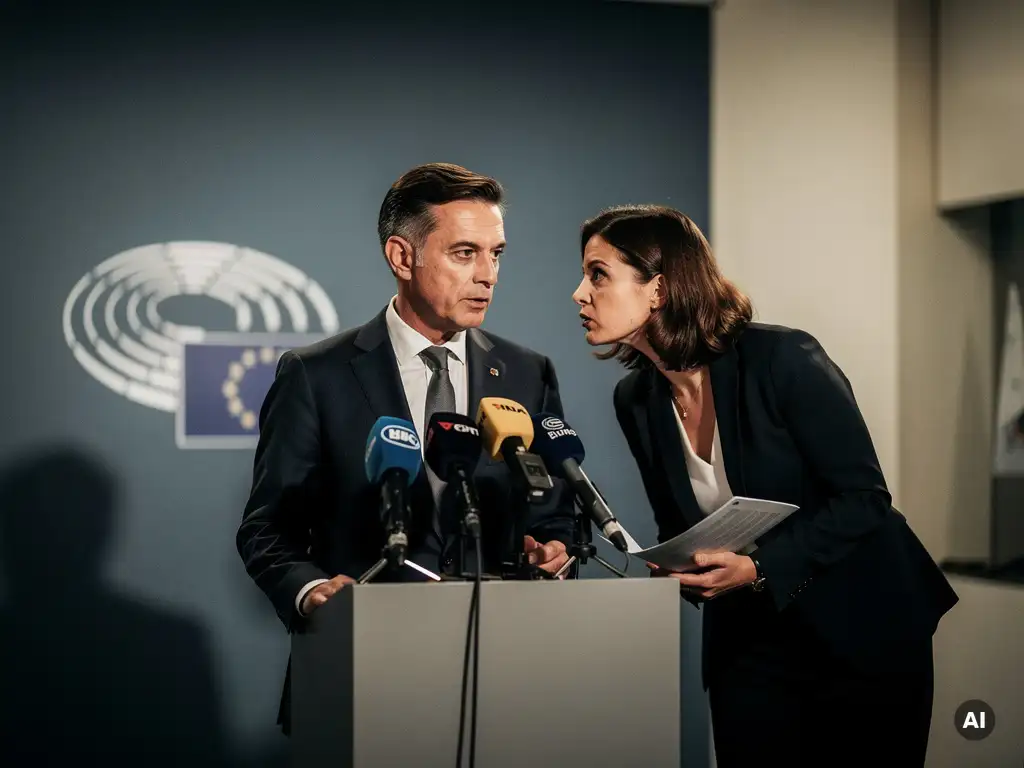
Preparing a spokesperson well for a press conference during a crisis requires a combination of clear messaging, targeted practice, and a well-defined decision-making structure. Preparation does not begin on the morning of the press conference, but well before that: in the crisis communication planning built long before an incident occurs. The questions below give senior decision-makers concrete guidance at every phase of that preparation.
What messages should a spokesperson have ready before the press conference?
Before a press conference during a crisis, a spokesperson must have three to five key messages that the organization wants to communicate consistently: what happened (based on confirmed facts), what measures the organization is taking, and what impact this has on the stakeholders involved. These messages form the anchor of every answer, regardless of the direction of the questions.
In addition to the key messages, the spokesperson needs an up-to-date and internally aligned fact sheet. That document contains only confirmed information and makes clear what is not yet known or cannot be communicated. It prevents contradictory statements between the spokesperson, management, and other internal communicators.
Also essential is a prepared Q&A document with the most anticipated journalist questions and the approved answers to them. That document is not intended for memorizing answers, but to help the spokesperson respond quickly and consistently without improvising on sensitive points. Legal, HR, and management must have approved this document in advance.
- Three to five key messages, internally aligned and approved
- An up-to-date fact sheet based on confirmed information
- A Q&A document with anticipated questions and approved answers
- Clarity on what can and cannot be communicated
- Alignment with Legal, HR, and the crisis team on the boundaries of communication
How far in advance should you train a spokesperson for a crisis?
Media training for a crisis ideally starts long before any incident occurs. Organizations with an elevated risk profile schedule annual media training sessions as a fixed part of their crisis preparedness. Waiting until a crisis breaks out to prepare a spokesperson wastes valuable time at the moment when speed and consistency matter most.
Structural preparation consists of two layers. The first layer is foundational training: a spokesperson learns how media operate during a crisis, how to formulate messages clearly, how to handle difficult questions, and which pitfalls to avoid. That training can be supplemented with scenario-specific exercises based on real risks for the organization.
The second layer is situation-specific preparation shortly before a press conference. Even an experienced spokesperson needs a brief, focused briefing on the specific context, the key messages, the anticipated questions, and the boundaries of communication. That preparation takes at least one hour, preferably including a short practice round.
What questions do journalists ask most often during a crisis press conference?
During a crisis press conference, journalists typically focus on six recurring themes: exactly what happened, who is responsible, what the consequences are for people or society, what the organization is concretely doing now, whether this could have been prevented, and what will be done differently in the future. A spokesperson who has an answer ready on each of these axes is in a strong position.
Specific questions that frequently come up:
- When did you know about this, and why didn’t you communicate sooner? Journalists test the transparency and timeliness of communication.
- Who is responsible? The question of accountability is almost always present, even when an investigation is still ongoing.
- What are the consequences for the victims or those affected? Human impact takes priority in media coverage.
- Can you guarantee this will not happen again? A question that traps spokespeople who make promises too quickly.
- What do you say to people who don’t trust you? A direct challenge to the credibility of the organization.
The spokesperson must also account for questions that play on rumors or social media. Journalists often arrive already carrying information or claims that are circulating. Good preparation takes those scenarios into account as well.
How does a spokesperson handle questions they are not allowed or able to answer?
A spokesperson who cannot or is not allowed to answer a question says so explicitly and briefly explains why, without hiding behind vague formulations. Phrases such as “I cannot confirm that at this time because the investigation is still ongoing” or “That information is not available at this time” are more credible than evasive behavior or an abrupt “no comment.”
The key is bridging: the technique whereby the spokesperson, after honestly acknowledging the limitation, returns to what they can say. That requires practice. A spokesperson who lingers too long on what they cannot say loses the narrative. Those who quickly and convincingly redirect the conversation to the key messages retain more control over the communication.
Before the press conference, it must be internally clear which categories of information cannot be communicated, and why. Think of ongoing legal proceedings, confidential personnel information, information that could influence the investigation, or commercially sensitive data. Those boundaries are determined in collaboration with Legal, HR, and the crisis team — not by the spokesperson alone.
What are the biggest mistakes spokespeople make during a press conference?
The most common mistakes during a press conference in a crisis are speculating about causes that have not yet been confirmed, making promises about the future too quickly, and responding defensively to critical questions. Each of these mistakes increases reputational damage rather than limiting it.
- Speculating: Statements about causes, numbers, or consequences that have not yet been confirmed create a second problem when the facts later turn out to be different.
- Uncontrolled emotions: Visible nervousness, anger, or defensiveness undermine credibility, even when the content is correct.
- Inconsistent messages: When the spokesperson says something different from what was previously communicated internally or externally, the organization quickly loses credibility.
- Unprepared silences: Long pauses or visible uncertainty in response to anticipated questions create the impression that the organization is hiding something.
- Apologizing or acknowledging liability too quickly: Showing empathy is appropriate and necessary, but legally sensitive admissions must be aligned with Legal in advance.
- No closing: A press conference without a clear closing or next step leaves journalists with open questions, which encourages speculation.
Who decides who the spokesperson is during a crisis?
The choice of spokesperson during a crisis is a strategic decision that is established before the crisis in the crisis communication plan and is not improvised at the moment itself. In most organizations, the communications director or Corporate Affairs lead is the primary spokesperson, but depending on the type of crisis and the expected media attention, the CEO or another member of the executive team may also take on that role.
The choice depends on several factors: the severity and visibility of the crisis, the type of stakeholders the organization wants to reach, the media training and experience of the candidate spokesperson, and the specific context. In a cyber incident involving technical questions, a CISO or IT lead can play a supporting role. In a restructuring with social impact, the CEO is often the most credible voice.
It is important that a backup spokesperson is always designated. Crises develop quickly and over multiple days. One person cannot always carry that pressure alone. The division of roles, including who addresses which stakeholders, is determined in advance and communicated internally so that everyone consistently follows the same line.
How do you evaluate a spokesperson’s performance after a press conference?
After a press conference during a crisis, you evaluate the spokesperson on three levels: the substantive consistency of the messages, communicative effectiveness, and the impact on media and stakeholders. That evaluation takes place as soon as possible after the press conference, as part of a broader hot debrief of the crisis team.
Substantively, you assess whether the key messages were conveyed correctly and consistently, whether the spokesperson stayed within the agreed boundaries, and whether any statements were made that require correction or clarification. Communicatively, you assess tone, clarity, body language, and the way difficult questions were handled.
Media impact is measured through monitoring: which messages were picked up in coverage, which quotes were used, what framing journalists are applying, and which questions remained unanswered in the coverage. That analysis provides direction for further communication in the hours and days following the press conference.
The evaluation is not an accountability exercise, but a learning tool. Findings are incorporated into the post-incident review and translated into improvements to the crisis communication plan and future training sessions. In this way, every crisis also becomes an investment in better crisis preparedness.
How Whyte helps prepare spokespeople for a crisis
Whyte Corporate Affairs guides organizations through the complete preparation of spokespeople for press conferences and other communication moments during a crisis. This is not done as isolated media training, but as part of an integrated approach in which key messages, stakeholder priorities, internal alignment, and communication structure are developed together.
Concretely, Whyte offers, among other things:
- Media training and spokesperson coaching for CEOs, executive team members, and other spokespeople in their professional role on behalf of the organization
- Development of key messages, Q&A documents, and fact sheets tailored to the type of crisis
- Scenario-specific crisis simulations, including practice press conferences with realistic journalistic pressure
- Guidance on selecting and preparing the right spokesperson for each type of crisis
- Support during the acute crisis phase, including crisis communication and reputation management at strategic and operational level
- Evaluation and debriefing after a press conference or crisis moment
Would you like to know how Whyte can help your organization prepare for a crisis? Get in touch for an initial conversation.
Frequently Asked Questions
How quickly should an organization hold a press conference after a crisis breaks out?
The timing of a press conference depends on the severity and visibility of the crisis, but the basic principle is: communicate early, even if you don’t yet have all the facts. A brief initial statement within the first few hours — acknowledging what has happened, indicating that you are taking action, and promising to provide more information as soon as it becomes available — is better than silence. Silence is quickly filled by media and stakeholders with speculation, which increases reputational damage.
What do you do if the spokesperson makes a mistake or says something incorrect under pressure during the press conference?
Correct the mistake as quickly as possible, preferably during the press conference itself or via a written statement immediately afterward. Do not try to conceal or minimize the error: journalists will notice the discrepancy and it increases distrust. A clear correction — ‘I want to clarify an earlier answer: the correct information is…’ — demonstrates transparency and limits further damage. Also incorporate the error into the evaluation and the Q&A document for follow-up communication.
Can an organization deploy multiple spokespeople during one and the same crisis?
Yes, but this requires a strict division of roles and tight internal alignment. Multiple spokespeople can be useful when the crisis touches different domains — think of a technical spokesperson for operational questions and an executive team member for strategic or human impact. The danger is inconsistency: if spokespeople convey even slightly different messages, confusion and loss of credibility arise. Ensure there is one central coordinator who monitors all lines of communication.
How do you handle social media and online rumors that are already circulating during the press conference?
Prepare the spokesperson specifically for questions based on social media or online rumors, as journalists increasingly bring these to a press conference. The approach is twofold: acknowledge that you are aware of the reporting, but only correct based on confirmed facts and avoid repeating or amplifying the rumor. Internally, the crisis team must actively monitor social media during the press conference so that the spokesperson can be immediately updated on new developments afterward.
What is the difference between media training and a crisis simulation, and do you need both?
Media training focuses on the foundational skills of a spokesperson: formulating messages, handling difficult questions, body language, and bridging techniques. A crisis simulation goes a step further: a realistic crisis scenario is played out, including time pressure, incomplete information, and journalistic pressure, so that the entire crisis team — not just the spokesperson — gets to practice. Both are necessary: media training lays the individual foundation, while the crisis simulation tests whether the organization as a whole is ready to apply that foundation under pressure.
How do you ensure that internal employees don't respond to journalists' questions outside the official press conference?
This starts with clear internal communication as soon as a crisis breaks out: employees must know who the official spokesperson is, that all media inquiries go through that person, and how they themselves should respond if a journalist contacts them directly. A standard phrase such as ‘Please direct all questions to our spokesperson at [contact details]’ must be shared internally. Organizations with an elevated risk profile include this protocol in their crisis communication plan and practice it during crisis simulations.
When is it appropriate for the CEO to speak rather than the communications lead?
The CEO is the most appropriate spokesperson when the crisis has a direct impact on people, strikes at the core of the organization, or when the credibility and trust of stakeholders are at stake. Think of serious workplace accidents, major restructurings, or ethical issues. For more operational or technical crises, the communications lead or a domain expert may suffice. The choice must be established in advance in the crisis communication plan, so that it is not made ad hoc under time pressure.
Related Articles
- How to Restore Customer Trust After a Product Incident
- How Do You Prepare Employees for a Potential Business Crisis?
- What Is a Post-Incident Review and When Should You Conduct One?
- How to Prevent Rumors From Escalating During an Organizational Crisis
This content was generated with the help of AI and it may contain mistakes