
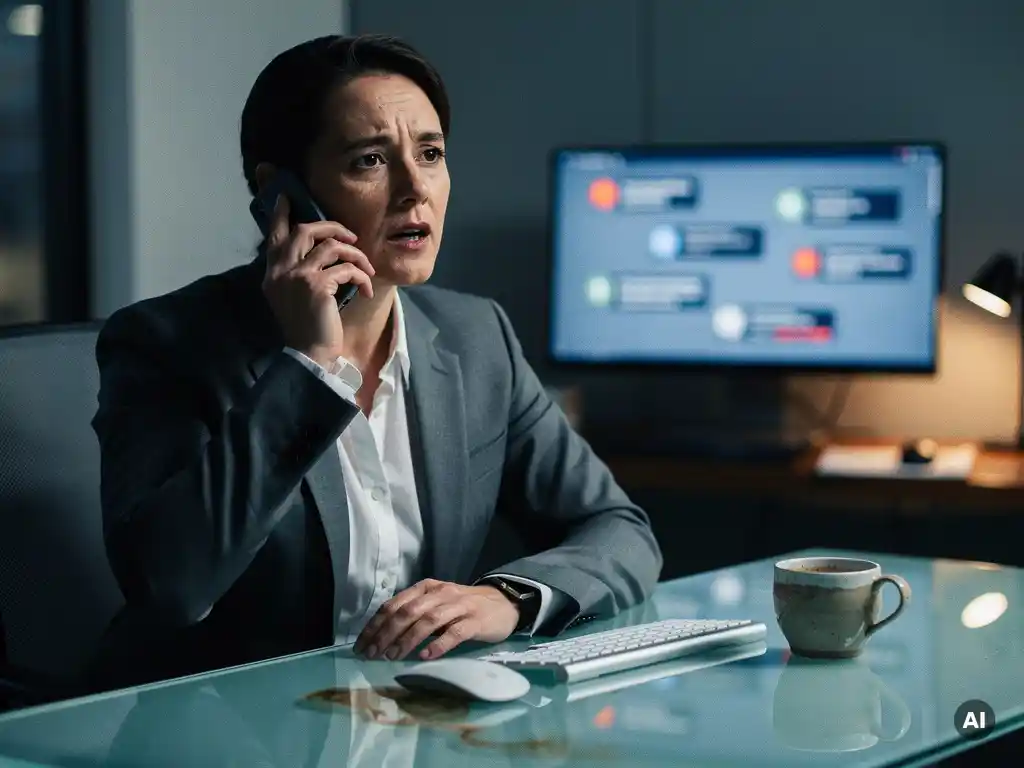
When facing a serious product issue, you communicate with customers by acting quickly, transparently, and in a coordinated manner: acknowledge what is happening, explain what the organization is doing, and tell customers what they can expect. The faster and more honestly that message is communicated, the greater the chance of maintaining trust. The questions below provide concrete guidance for every phase of product crisis communication.
What are the biggest communication mistakes during a product crisis?
The biggest communication mistakes during a product crisis are waiting too long to communicate, saying too little out of fear of liability, and sending contradictory messages to different audiences. Each of these mistakes amplifies customer anxiety and gives media and critics room to fill in the narrative themselves.
In practice, organizations regularly fall into the same pitfalls:
- Silence as a strategy: Not responding while customers and media are already asking questions. Silence is quickly interpreted as guilt or negligence.
- Minimizing or denying: Downplaying the problem or denying facts that later come to light anyway. This structurally damages credibility.
- Legal jargon as a shield: Communication that is entirely dictated by legal caution, without any human tone or acknowledgment of the impact on customers.
- Fragmented communication: Customer service says something different from the spokesperson, while the website still mentions nothing. Inconsistency undermines trust faster than the problem itself.
- Claiming too early that everything is resolved: A premature “all clear” that later has to be retracted is particularly damaging to reputation.
Product crisis communication requires coordination between Legal, Communications, Operations, and Management, so that a single consistent message is maintained externally.
Which customers should be informed first?
During a product issue, the customers who face the greatest risk or experience the greatest impact are informed first. Next come customers with a strategic relationship or high visibility, and finally the broader customer group through generic channels.
Prioritization depends on three factors: the severity of the risk to the customer, the nature of the customer relationship, and the likelihood of external dissemination of information.
In practice, this typically means the following order:
- Customers with a direct safety or health risk: They must be reached immediately, through direct communication such as phone, email, or personal contact.
- Large or strategic customers: Business partners, distributors, or customers with high volume or high visibility expect proactive communication, preferably through their regular contact person.
- Customers who have already received or used the product: They need practical information about what to do, even if the risk is limited.
- The broader customer group: Via website, email, or social media, once the core message has been established and operational follow-up has been arranged.
Customers who are informed through third parties or media before the organization has communicated itself feel sidelined. That feeling is harder to repair than the product issue itself.
What should a first customer message about a product issue contain?
A first customer message about a product issue should contain four elements: a clear acknowledgment of the problem, a description of the impact on the customer, a concrete course of action, and an announcement of further communication. Completeness is less important than speed and honesty.
In the early phase of a product crisis, it is tempting to wait until all the facts are known. That is a mistake. A good first message does not need to contain everything, but it must be credible. Use the following structure for this:
- Acknowledgment: Confirm that there is a problem, without minimizing or exaggerating. “We are aware of an issue with [product/batch/service] and are taking it seriously.”
- Impact on the customer: What does this concretely mean for the recipient of the message? Should they stop using it, return something, get in touch?
- What the organization is doing: What steps are being taken? Investigation, recall, replacement? Indicate what has been set in motion, even if that is still limited.
- Follow-up communication: When and how will the organization communicate again? A concrete commitment reassures customers.
- Contact option: Refer to a specific point of contact, phone number, or email address for questions.
Avoid speculation about causes, assignment of blame, or legal qualifications in the first message. Those belong in a later phase, after alignment with Legal and after verification of the facts.
How do you prevent contradictory messages to different stakeholders?
You prevent contradictory messages by creating a single central fact base and having all communication originate from one coordination point. This means that customer service, the spokesperson, social media, and internal communications all use the same core messages, adapted to the specific audience but not deviating in substance.
During a product crisis, there are typically multiple channels and functions communicating simultaneously: customer service answers questions, the spokesperson responds to media, HR informs employees, and account managers speak with business customers. If that communication is not coordinated, inconsistencies arise that damage trust more quickly than the problem itself.
Practical measures to prevent this:
- Appoint one crisis coordinator who monitors and approves the flow of communication.
- Work with a central message house: core messages that apply to all audiences, with a tailored tone and context per audience.
- Brief everyone who communicates externally, including customer service and account managers, before communication goes out.
- Use a shared Q&A document that is updated in real time as new questions come in.
- Establish clear escalation criteria: which questions may be answered directly and which are forwarded to the spokesperson or Legal?
The crisis communication approach of an organization is only as strong as its internal coordination. External consistency always starts internally.
When do you switch from reactive to proactive communication?
The switch from reactive to proactive communication during a product issue is made once the facts have been sufficiently verified, operational follow-up has been arranged, and the organization has something concrete to communicate about remedial measures or next steps. That moment often comes sooner than organizations think.
Reactive communication is by definition responsive: the organization reacts to questions, complaints, or media attention. Proactive communication means the organization itself takes the initiative to inform customers and stakeholders, even without a direct external trigger.
The switch is appropriate when:
- The scope of the problem is clear and the organization knows exactly who has been affected.
- There is a concrete measure or solution that can be communicated, such as a recall, compensation arrangement, or repair procedure.
- There is a risk that customers will be informed through other channels, such as media or social media, before the organization has communicated itself.
- Trust is visibly beginning to erode and a proactive message can turn the tide.
Proactive communication is not a sign of weakness, but of control. Organizations that take the initiative themselves also help shape how the story is told.
How do you restore customer trust after a serious product issue?
You restore customer trust after a serious product issue by communicating transparently about what went wrong, taking concrete remedial measures, and actively communicating those measures over an extended period. Trust is not restored with a single message, but with consistent behavior that is supported by communication.
After the acute phase of a product crisis, the recovery work begins. Customers want to know not only that the problem has been resolved, but also that the organization has learned from what went wrong and that it will not happen again.
Effective trust recovery requires:
- Transparency about cause and approach: Explain what went wrong and what structural measures have been taken. Avoid vague formulations.
- Visible follow-up: Communicate not only that measures have been taken, but also what those measures concretely entail and when they will take effect.
- Acknowledgment of impact: Customers who have experienced inconvenience expect that impact to be acknowledged, even when there is no formal liability.
- Consistent long-term communication: One good message is not sufficient. Plan follow-up moments at which the organization demonstrates that the situation is under control and improvements have been implemented.
- Proof points: Use concrete facts and results to demonstrate that the organization is keeping its promises.
Reputation recovery after a product crisis is a process of months, not days. Organizations that actively manage that process emerge stronger than organizations that cease communication after the acute phase.
How Whyte helps with product crisis communication
Whyte guides larger organizations and multinationals through the full cycle of a product crisis, from the first hours to the long-term recovery of customer trust and reputation. That guidance is integrated: communication, stakeholder management, media relations, and internal coordination are treated as a single whole, not as separate silos.
Concretely, Whyte offers support with:
- Creating situational awareness and a single reliable fact base in the acute phase.
- Developing core messages, Q&A documents, and holding statements for all relevant audiences.
- Coordinating customer communication, internal briefings, spokesperson activities, and media relations.
- Determining stakeholder priorities: who do you inform when, through which channel, and with which message?
- Coaching spokespersons and executives in their communication role on behalf of the organization.
- Post-crisis evaluation, reputation analysis, and developing a recovery strategy.
- Crisis preparedness and simulations to make organizations more resilient for a future incident.
Is your organization facing a product issue, or do you want to be better prepared for what may come? Contact Whyte for an initial conversation.
Frequently Asked Questions
How quickly should an organization respond after discovering a serious product issue?
The rule of thumb is: communicate internally within the first hour and externally within the first two to four hours, even if not all the facts are yet known. A brief holding statement — in which you acknowledge that there is a problem and that you are working on it — is sufficient in that initial phase. Waiting until you know everything costs more trust than an honest but incomplete first message.
What is a holding statement and when do you use it?
A holding statement is a short, cautious message that you deploy while the facts have not yet been fully verified. It confirms that the organization is aware of the problem, that action is being taken, and that further communication will follow. It is not a definitive answer, but it fills the dangerous communication void that would otherwise be filled by media or rumors.
How do you handle customers who complain publicly on social media during a product crisis?
Respond quickly, empathetically, and consistently to public complaints, but move the conversation to a private channel such as email or phone for substantive follow-up as quickly as possible. Avoid discussions or defensive responses in public. Every public response is visible to a broader audience, so show understanding, confirm that you are taking the situation seriously, and refer to a concrete point of contact.
What role does Legal play during product crisis communication and how do you prevent legal caution from paralyzing communication?
Legal plays an essential role in managing liability risks, but should not be allowed to dictate communication entirely. The solution is a structured collaboration in which Legal and Communications jointly validate the core messages: Legal monitors what must not be said, Communications monitors what must be said to maintain customer trust. Clarify that division of responsibilities in advance, so that no time is lost to internal discussions during the acute phase.
Should an organization always communicate the cause of a product issue publicly?
Not immediately, but ultimately yes. In the acute phase, it is sufficient to acknowledge that there is a problem and what measures are being taken. The cause is communicated only after it has been internally verified and aligned with Legal. When the cause is known, transparency is the best strategy: customers and media will otherwise fill a communication vacuum themselves, often in a way that is more damaging than the reality.
How do you prepare customer service staff for a product crisis?
Ensure that customer service is briefed before external communication goes out, with a clear Q&A document containing the core messages, the questions to be expected, and the escalation criteria. Staff must know which questions they may answer themselves and when they should refer to a spokesperson or crisis coordinator. A poorly informed customer service team is one of the fastest sources of inconsistent communication during a crisis.
How do you know whether your crisis communication has been effective?
Measure effectiveness using concrete indicators: the speed at which complaints decrease, the tone of media coverage (negative, neutral, or positive), customer satisfaction scores in the weeks following the crisis, and the number of escalations or legal claims. Also conduct a post-crisis evaluation in which you review the communication approach internally: what worked, what did not, and what needs to be adjusted for a future incident.
Related Articles
- How to Set Up an Early Warning System for Reputation Risks
- How Does an Organization Handle a Boycott or Public Backlash?
- How to Manage Social Media During a Reputation Crisis
- How Does a Crisis Team Work Within a Large Organization?
- Why Is Rapid Communication in the First Hours of a Crisis So Crucial?
This content was generated with the help of AI and it may contain mistakes